

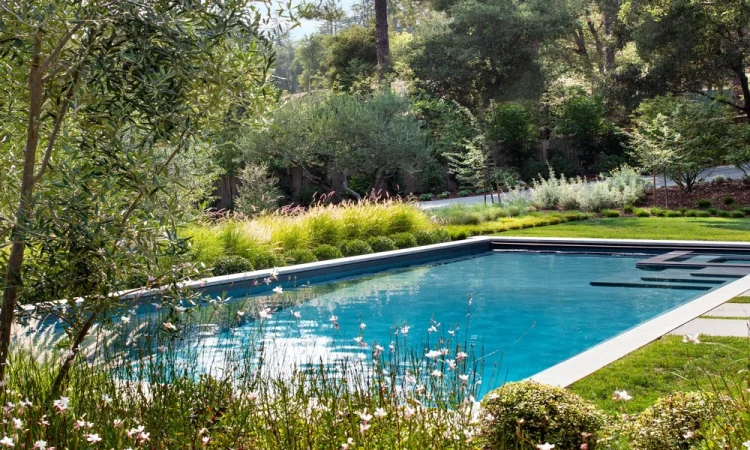
Pool coping deserves a closer inspection than a colour sample can provide. When choosing the material around the pool edge, ask to see the proposed profile and understand how it will meet the water and surrounding patio. Its shape, surface and junctions are part of the daily experience, even when the overhead photograph makes it look like a simple border.
A renovation is an opportunity to notice an edge you may have stopped thinking about. You might like the appearance of the existing coping but dislike one particular detail, or want a new finish without changing the whole pool. Describe that experience before choosing a replacement by its colour name.
Find the actual edge within the material sample
A small flat sample can help with colour and surface appearance. It may tell you much less about the part that projects, turns or meets another material. Ask whether the sample represents the finished coping unit or only a material available in several different profiles.
Have the designer identify the proposed top, exposed face and edge treatment. You do not need to learn every trade term, but you should be able to recognise the detail that is being priced. Two products made from a similar material can create noticeably different edges.
Look at a representative full piece when one is available. If the display uses a different size or profile, ask which parts of the example remain relevant. A salesperson pointing to a broad material family is not necessarily showing the exact item that will be installed.
Consider how much of the coping will be visible from your ordinary position beside the pool. An overhead sample board emphasises the top, while someone sitting nearby may notice the face and underside relationship more. Ask for an explanation or relevant example of the proposed finished detail rather than imagining those parts from the swatch.
Compare contact, not just colour
Where the showroom permits, handle a clean sample and notice its texture and edge shape. This gives useful information about personal preference, but it is not a substitute for product suitability testing. Do not treat a brief touch as proof of slip resistance, temperature performance or any other technical property.
Tell the designer which existing experiences you want to change. Perhaps an edge feels visually heavy, a surface is unpleasant to rest a hand on, or a particular junction is difficult to keep presentable. Specific observations are more useful than asking for something softer or more luxurious without explaining what those words mean to you.
Ask for the manufacturer’s intended applications and care information for the actual material. The supplier or designer should address suitability for the proposed poolside use. Avoid assuming that a surface approved for one outdoor setting automatically belongs in every pool-edge detail.
For an existing Mississauga or Oakville pool, pool-edge renovation options from Jameson Pool & Spa include assessment and coping work described on its renovation page. Have the existing condition and construction reviewed before making a purely decorative selection. A new profile must be considered in relation to what is already there.
Keep the aesthetic preference and the technical answer connected. If the first choice is unsuitable for the assessed arrangement, ask what alternatives preserve the qualities you liked. The result may be a different product with a similar visual weight or edge character, rather than a forced attempt to use the original sample.
Ask how the profile continues around the pool
A straight sample does not explain a corner. Ask how the selected profile will turn, meet a curved section or terminate beside another feature in your pool. These details influence whether the edge reads as a coherent element or a series of unrelated pieces.
Look at the transitions where people naturally focus their attention: near the main entry, beside a bench or where the patio material changes. Ask the project team to explain the relevant junction, including what will remain visible. You are reviewing the appearance and use, while the team remains responsible for the construction method.
Discuss the proposed joint appearance as part of the overall rhythm. A small sample seen alone can make you overlook the repeating lines around a larger perimeter. Ask for representative examples where possible, and establish what is illustrative versus specific to your proposed installation.
Include the existing liner or other pool finish in the assessment without turning the coping decision into another full palette exercise. The key question is how the physical junction will work and look. If related work is necessary, have it identified clearly instead of assuming that replacing the visible edge leaves every adjacent component untouched.
Where the patio will remain, ask how its relationship with the new coping has been assessed. Do not prescribe a height adjustment or filler detail yourself. Explain the finish you want to see, then let the responsible professionals develop a suitable response to the existing conditions.
Keep the chosen detail through the renovation
Retain the product identification, size and profile with the approved selection. A colour name alone may not distinguish the piece you evaluated from another item in the range. If a substitution is proposed, revisit the edge shape and relevant junctions as well as the appearance of the material.
Ask how a sample’s variation should be understood across the supplied material. A representative piece can inform the choice without guaranteeing that every installed unit will look identical. The supplier should explain what is characteristic of that product and what would require further review.
After installation, follow the care information provided for the completed work. Do not use an abrasive, sealant or cleaning product merely because it was appropriate for the old coping. If the finished detail differs from what you understood, raise the specific concern with the project team before attempting to alter it.
The edge you choose will be encountered at close range, not only admired across the garden. Take enough time to understand its profile and the way it continues around the pool. A successful selection is one you recognise in the finished detail, with its physical character as deliberate as its colour.

