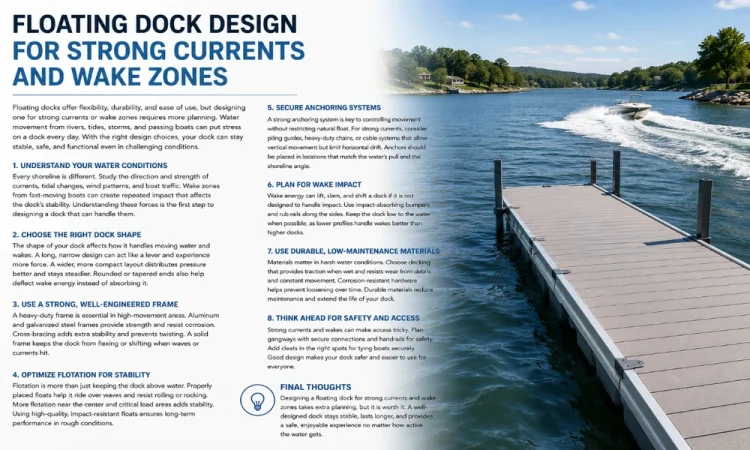
Floating docks are popular because they rise and fall with the water. They work well in many waterfront settings, but not every location is calm. Some docks sit in areas with strong currents, changing tides, passing boats, or heavy wake. In these places, design matters a lot more.
A floating dock in a high-movement area must handle pressure from several directions. Water may push from below, from the side, or at an angle. Boat wakes can lift, drop, and twist the dock throughout the day. Without the right design, the dock may feel unstable, wear out faster, or become harder to use safely.
Good floating dock design for strong currents and wake zones starts with understanding the site.
Study the Water Before Designing the Dock
Every shoreline has its own conditions. Some areas have steady current. Others only become rough during storms, tides, or busy boating hours. Before choosing a dock layout, it helps to observe the water at different times of day and in different weather.
Look at the direction of the current, the strength of passing wakes, the depth of the water, and how the shoreline is shaped. A dock placed against the natural movement of the water will take more stress. A dock positioned with the movement may perform better and last longer.
This step is easy to overlook, but it is one of the most important parts of the process.
Choose a Strong Frame System
The frame is the backbone of a floating dock. In calm water, a lighter frame may be enough. In strong current or wake zones, the frame needs extra strength and stiffness.
A strong dock frame helps reduce twisting, bending, and uneven movement. Cross bracing can also improve stability by keeping the dock sections aligned. When waves or current hit the dock, bracing helps spread the force instead of letting one area take all the pressure.
The dock should also be designed for the expected load. Boats, people, gear, carts, and equipment all add weight. If the dock is underbuilt, movement and flex become more noticeable.
Use Proper Flotation Placement
Flotation does more than keep the dock above water. It also affects how the dock reacts to waves and current. Poor flotation placement can cause the dock to bounce, roll, or dip in certain areas.
In wake zones, floats should be arranged to support the dock evenly. High-traffic areas, corners, boat slips, and gangway connections may need extra support. More balanced flotation helps the dock ride the water instead of fighting it.
Float quality matters too. Floats should be durable, impact-resistant, and suited for the water conditions. Weak or damaged floats can reduce stability and create long-term maintenance problems.
Plan the Anchoring System Carefully
Anchoring is one of the most important parts of dock design in moving water. A floating dock should be able to rise and fall, but it should not drift too far, twist sharply, or pull against its connections.
Different sites require different anchoring methods. Some docks use pilings. Others use cables, chains, stiff arms, or weighted anchors. The right choice depends on current strength, water depth, bottom conditions, wind exposure, and shoreline layout.
In strong currents, the anchoring system must control horizontal movement while still allowing vertical movement. If the system is too loose, the dock may swing. If it is too tight, it may place too much stress on the frame and hardware.
Reduce Wake Impact With Smart Layout
Wake from passing boats can cause sudden lifting and dropping. A dock with a wide, stable layout often handles wake better than a narrow dock with long unsupported sections.
Bumpers, rub rails, and protective edging can help absorb impact from boats and reduce wear. In some locations, the dock layout can also be adjusted to reduce direct exposure to wake. Even a small change in angle or position can improve comfort and performance.
Use Hardware Made for Harsh Conditions
Dock hardware takes a beating in strong currents and wake zones. Bolts, brackets, hinges, and connectors must resist corrosion, vibration, and constant movement.
Marine-grade hardware is usually the better choice for waterfront conditions. It helps keep connections secure and reduces the chance of early failure. Regular inspections are still needed because movement can loosen parts over time.
Keep Safety in the Design
Strong currents and wake zones create extra safety concerns. The dock surface should provide good traction, especially when wet. Gangways should connect securely and allow safe access as water levels change.
Cleats, ladders, lighting, and life safety equipment should be placed where people can reach them easily. Walkways should remain clear of ropes, cords, and loose gear.
Final Thoughts
Floating dock design for strong currents and wake zones requires more planning than a dock in calm water. The frame, flotation, anchoring, layout, and hardware all need to work together.
A well-designed floating dock will still move, because that is part of how it functions. But it should move in a controlled way. With the right design choices, a floating dock can stay stable, safe, and useful even in active water conditions.
This post was written by a professional at Supreme Marine Floating Docks. Supreme Marine Floating Docks is dedicated to providing top-quality floating dock services Ft Lauderdale and marine accessories that combine durability, innovation, and superior performance. While we are a new brand, our team brings over 50 years of combined industry experience, making us a trusted name in the marine world. We are passionate about designing and delivering products that meet the highest standards, ensuring reliability and longevity in all marine environments. Whether for residential, commercial, or recreational use, our docks are crafted with precision and care, setting a new benchmark in the industry. At Supreme Marine, we don’t just build docks-we create lasting solutions.